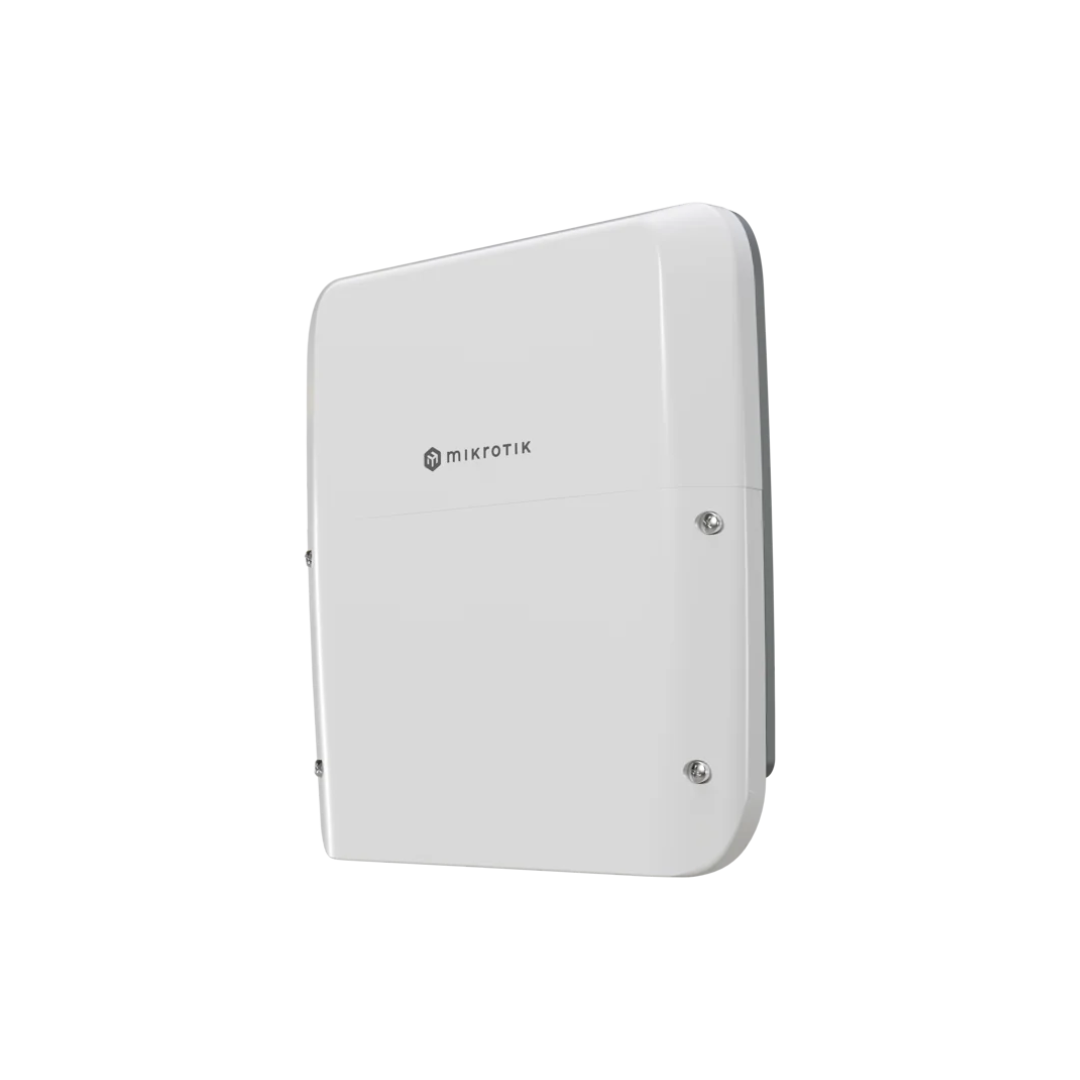
Tower and rooftop sites usually need a router, a PoE source for radios, and a separate enclosure, each a point of failure. This unit combines those roles in a sealed case, and its RouterOS v7 CPU is intended for ISP workloads such as PPPoE termination, DHCP to customers, queuing, MPLS, VPLS/VXLAN termination, and hardware bridging.
- IP66 enclosure, -40 °C to +70 °C tested range, passive cooling: Sealed and fanless, so there are no moving parts to fail at an exposed site.
- Nine powering options, 24 V to 57 V: The router uses the source with the highest voltage. MikroTik states that with PoE-in it stays on if eight of the nine sources are lost.
- PoE-out on Ether1 to Ether8: Up to 25 W per port and 130 W total, so radios or cameras can be powered from the router itself.
- 7x 1G, 1x 2.5G, 1x 10G SFP+: Copper ports for local equipment and an SFP+ cage for a fibre uplink or link to a core switch.
- Quad-core CPU up to 1.4 GHz, 1 GB DDR4 RAM, 1 GB NAND: Provides the processing headroom for ISP-style routing features in RouterOS v7 with a level 5 license.
- Voltage, current, and temperature monitoring: Lets operators watch power and thermal conditions at a remote site.
Check before deployment: all power sources must share one voltage, as they cannot be mixed. PoE-out only works when power is also supplied to the 2-pin terminal, and the output mode follows that voltage, 802.3af/at or low voltage. The supplied adapter is rated at 96 W total, below the 130 W PoE-out maximum, so heavy PoE loads need a stronger supply, and MikroTik lists the MTP250 26 V and 53 V outdoor supplies as compatible.
The Simplifi Advantage
Power design is where outdoor router deployments most often go wrong. Simplifi Networks, a MikroTik Master Distributor for Kenya and Uganda, supplies genuine RB5009UPr+S+OUT units and can help ISPs and installers match supply voltage and PoE load to the site before it is climbed.